
PERIMETER SOLUTIONS
FIRE FIGHTING FOAM

CLASS A

CLASS A/B
1% FLUORINE FREE
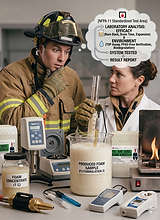
UNDERSTANDING UL WETTING AGENT TESTING
PHOS-CHEK WD881
-
PHOS-CHEK® WD881 Class A Foam concentrate is specially formulated to make water more effective for firefighting.
-
The unique combination of surfactants in PHOS-CHEK WD881 significantly reduces water’s surface tension and, when mixed with air, creates a superior foam blanket that surrounds fuels with a thick layer of water. This creates a barrier between the fuel and the fire, knocking down the fire faster than water alone, and allowing fire fighters to see the areas of application. Making the water more effective reduces the amount of water needed to extinguish the fire, reduces water damage and increases fire fighter safety through quicker knockdown and reduced mop-up/overhaul requirements.
-
PHOS-CHEK WD881 is highly effective for fighting Class A fires when mixed with water at use rates of 0.1% to 1.0%.
-
PHOS-CHEK WD881 is the most concentrated Class A foam product available today. Other products contain significantly more water in the concentrate. This extra water means higher use rates will be required to achieve expected results.

ONE FOAM. 99% OF FIRES. NO PFAS
Class A/B Fluorine Free Foam
Solberg Spartan doesn't just make water better; it makes it work harder. With an ultra-lean 0.1% induction rate for Class A fires, you'll stretch your foam supply further than ever. More importantly, our advanced wetting technology allows the solution to penetrate deep into fuels, cutting total water demand by 40% and stopping property damage in its tracks
-
Ultra-Fast Knockdown: Reduces temperatures from 1,000°F to 212°F in half the time of water, protecting your crew from flashover conditions.
-
Industry-Leading Suppression: Engineered for faster knockdown and deeper penetration, Spartan provides the most effective extinguishment at the source, setting a new benchmark for fluorine-free performance.
-
Future-Proof Compliance: With no intentionally added PFAS, you’re meeting the strictest environmental regulations today and tomorrow.
-
Equipment Compatible: Low-viscosity "water-like" flow means it works perfectly with your existing inline eductors, CAFS, and nozzles.
Certifications
-
UL 162/ULC S654 Listed – 1% for Class B Hydrocarbon Non-Water Miscible Fuel Fires
-
UL/ULC Classified – 0.1% for Class A fires and 0.25% for Class B Non-Water Miscible Fires.
-
Class A Wetting Agent in accordance with ANSI/NFPA 18


What is UL Wetting Agent Test?
Are all fire fighting foams UL certified?
The UL Wetting Agent Test (governed by the ANSI/NFPA 18 standard) is a scientific "stress test." It is designed to prove that a concentrate can fundamentally change the structure of water, making it more aggressive, more absorbent, and more effective at extinguishing fire
The UL Wetting Agent test is technically voluntary for a manufacturer, but it is effectively mandatory for any department that wants to manage liability, insurance, and performance.
How are the UL tests performed?
To earn the UL mark as a wetting agent, a solution must pass three critical phases:
1. The Penetration Test 2. The Fire Suppression Test 3. The Corrosion and Compatibility Test
1. Penetration Test
2. Fire Suppression Test
3. Corrosion and Compatibility Test
-
The Method: A standard cotton canvas disk is placed on the surface of the liquid.
-
The Goal: In plain water, the disk will float for hours because the surface tension keeps it afloat. A certified wetting agent must "break" that tension, allowing the water to saturate the fibers so the disk sinks almost instantly.
-
The Method: Controlled fires are set using standardized "wood cribs" (Class A) and fuel spills (Class B).
-
The Goal: The test measures the total volume of liquid required to achieve a "knockdown." To pass, the treated water must extinguish the fire significantly faster and with less total volume than plain water. This proves the product increases the "cooling power" of every gallon pumped.
-
The Method: The concentrate is exposed to various metals used in fire apparatus, such as brass, aluminum, and steel.
-
The Goal: The test ensures that the solution is non-corrosive and won't damage tanks, pumps, or nozzles over time.
Once a product successfully clears the UL 162 / NFPA 18 testing suite, the manufacturer is authorized to display the UL Mark on product packaging and technical datasheets. This serves as third-party verification of performance and a standardized declaration of compliance—not a mere endorsement
Upon successful completion of the UL wetting agent test, the manufacturer’s specified induction rate is officially validated. This rate varies across the industry and serves as a primary indicator of the foam's chemical potency. A lower induction percentage signifies a more efficient concentrate, requiring less volume to achieve a certified extinguishment and allowing for significantly greater tactical endurance in the field.
What do the test results mean?

UL Testing Dictates Foam Controller Setting:
Class A Fire: Set minimum of 0.1
Class B Fire (Hydrocarbons): Set minimum of 0.25
Once a product successfully clears the UL 162 / NFPA 18 testing suite, the manufacturer is authorized to display the UL Mark on product packaging and technical datasheets. This serves as third-party verification of performance and a standardized declaration of compliance—not a mere endorsement
Upon successful completion of the UL wetting agent test, the manufacturer’s specified induction rate is officially validated. This rate varies across the industry and serves as a primary indicator of the foam's chemical potency. A lower induction percentage signifies a more efficient concentrate, requiring less volume to achieve a certified extinguishment and allowing for significantly greater tactical endurance in the field.
How do I compare foam with this information:
Below is a snapshot of the wetting agents test for two (2) A/B Foams, Fireball and Solberg Spartan


Class A Foam
-
This is the "Industry Gold Standard." It means the chemistry is so aggressive that it only takes 1 gallon of concentrate to treat 1,000 gallons of water.
-
5-gallon pail of Solberg Spartan will treat 5,000 gallons of water.
-
Fire Bull 0.25 requires 2.5 gallons of concentrate to treat the same 1,000 gallons of water.
-
5-gallon pail of Fireball A/B will treat 2,000 gallons of water.
On Class A fires, Solberg Spartan provides 2.5x the tactical endurance. You can stay on the nozzle longer and carry fewer pails to achieve the same certified result.
Class B Foam
-
Both products have reached the same elite level of performance here. They both transform water into a vapor-sealing blanket at a 1:4 ratio.
-
On a Class B Hydrocarbon Fire, either product will give you the same "yield" from a 5-gallon pail (2,000 gallons of finished solution).